19.9.17

Freefall: on Song to Song

[It is useless to read the following before my review of The Tree of Life, The Imaginary Family of Terrence Malick.]


Malick seems to be getting in tune, finding a post Tree of Life life. Song to Song is at times flawed, but at its best, as freefall cinema, this “fucking record” can indeed be magnificent, its soundtrack overdose reminding the Scorsese of the 90s. “I thought we could just roll and tumble, live from song to song, kiss to kiss.” While “they” do that, all’s fine. From memory to memory, from play to play, from association to association, the river flows. But then the director must deal with a plot and search heavily melodramatic moments: welcome to gravity.


Anyhow, there is less preaching. No cosmic imagery, or almost. Less scenario variations. There is nothing profoundly new in this film and yet it is fresher than Knight of Cups as Knight of Cups was fresher than To the Wonder, what finds a sort of echo in Faye’s story: “Fallen so low. I had to find my way out of you... to life.” We are once more – and now more clearly – promised a new beginning: “I got to go back and start it over. Like I kid. Didn’t had the right heart in me.” This time one feels a little expectation about it even if this new beginning is one of absolute circularity. Out of you to... you.
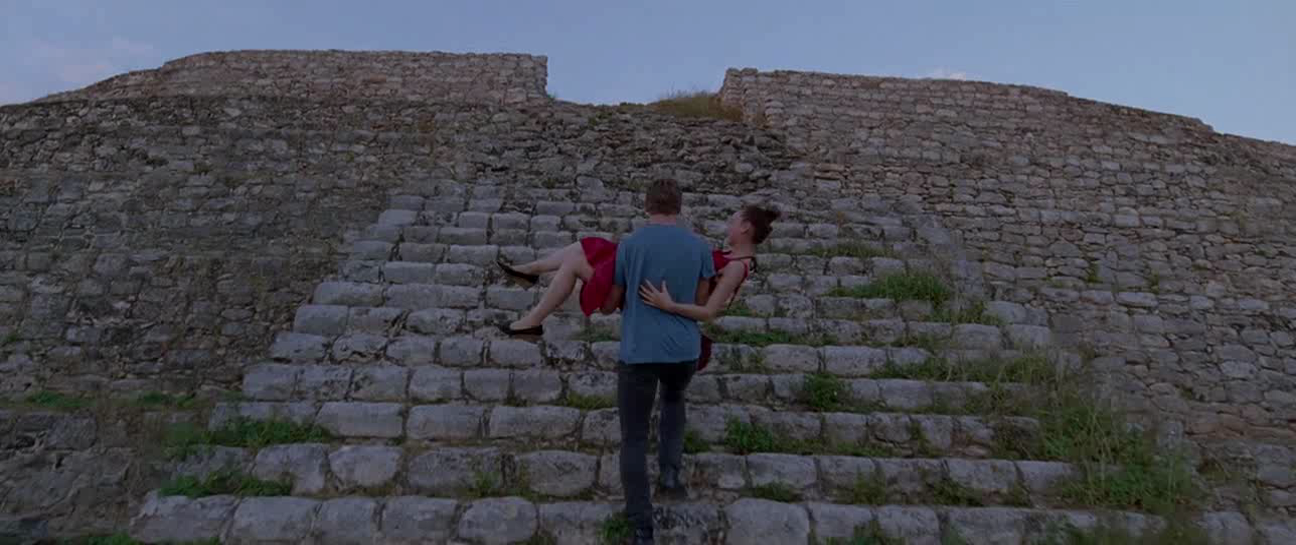
A (human) sacrifice. The idea of ascension is important in this film.

Dark screen, a tense soundtrack, as in Sunrise. The opening shot is incredible, a door (naturally...) slowly opening with Faye and Cook on each side of the wall, as if playing hide and seek. We watch fragments of the lives of the characters we will meet, the film starting to shape in the director's spiral. Faye tells us: “I wanted experience. I told myself: ‘Any experience is better than no experience.’ I wanted to live. Sing my song.” She wants to live her own life, just vivre sa vie. It had to be rough for a while and so on.


We will meet the mephistophelic guy on the other side of the door, Cook. He plays the fallen man, with similar thoughts to The Tree of Life’s architect: “I was once like you. Didn’t know what I know now. To think what I once was, what I am now.”
He runs the show and he warns us: nothing is real, nothing exists, it’s all a stageshow, just freefall. By now the guided tour is not necessary... The self-portrait continuous: “The world wants to be deceived.” “Here I reign, king.” The necessity to destroy and corrupt. Bloody cinephile visions. The asteroid, a Tree of Life’s reminiscence. The mushroom, naturally: “It’s soaked in God.” “Nobody was where we have been.” He lights the torches like in Apocalypse Now. The end of the river. A deep, dark river it is. Dark as the sun bathing the orgies. “What part of me you want?” He wants the part he doesn’t know. Fear excites him. Fear is a topic in this film. “Tell me what scares you.” “No, but what really scares you?” Answer: “I never knew my family.” Cook’s erotics is driven by fear, what is scarcely surprising at this point.


This director uses strong shots with symbolic suggestions to end his films. Not this time. The end is deliciously implausible and clichéd but works out very well. Bv and Faye decide to start a simple virtuous, working life. He goes ahead. She tells us about her love and all ends with a kiss at sunset in that slightly Bergmenesque rocks. “This, only this.” (“There is only this. All else is unreal.”, The New World) It is a memory of one of their first escapades, underlining the circular movement of the spiral.
Song to Song is probably the most serene (?) version of the director’s interminable confessions since Badlands. Adapting one of the songs: If you dont like his pictures, don’t shake his tree. Fair enough.
*
The themes and metaphors are the usual ones but generally refreshed. Examples:

To experiment
“He did everything. He exhausted every poison, he knew every form of love, suffering, madness, so that he could reach the unknown. He experimented.”

I doubt Godard is totally strange to this apparition of Rimbaud.

So he did. This program is made clearer than in the crucial The Tree of Life and it is made so through the quintessential outlaw, rebel, vagabond poet, Arthur Rimbaud, already quoted in To the Wonder. “Learn all the rules when you’re young, ‘cause that makes Mom and Dad happy. And then throw the fucking lot of them out the window.” The sovereignty of experimentation/experience is not to be separated from artistic expression: “The music it is all about feeling free. So you don’t have to do nothing to be free”, as one of the characters says. The experiment, the director's experiment, is, of course, the very film.
The unknow. The impossible. Jupiter and Beyond the Infinite, you name it. Cook says: “I want the part that I don’t know, that you don’t know yourself.” The cinema that cinema never imagined possible.

*

Identity
“You aren’t who you think you are.” This is the first time identity questioning comes to the foreground, with Malick (re-) introducing the soul in his musings. “Who am I?” “Am I a good person?”


Fay wears a thousand hair-styles, as Kit and Holly were always changing names. Fantastic the instability of her face, as if she is and is not the same person. She is the perfect women-kit-doll.


Persona seems to be around here at times.

*

Illusion
“Maybe you need this world. The falser, the show.” Maybe? Knight of Cups was about the movie world (or the world of movie people). This one is about the music one. The rock festival is this experiment's big metaphor and a new one. “Fuck the system. We have our one system. We have our own rules. Don’t answer to no one.” One can say this experiment finds a good mirror in this world, rebel and yet increasingly domesticated. Malick didn’t follow Rimbaud regarding the right time to leave poetry.


If the rock concert is essentially a new element, the party as a metaphor comes from the last film, which also dealt with erotic excesses, giving much relevance to beds and bedrooms. The analogy with prostitution is also again explicit. “I sell an illusion, you known, I sell a daydream to these guys.”

*

Architecture
“You gave moma a new home.” Definitely. Apartments, homes, big, small, all kinds. Pools and more pools. The city, Metropolis, is also a character, more discrete but always present.


*

Play/Game
“It wouldn’t be a very good job if I didn’t like kids, would it?”


Life and love as a play. “X marks the spot.” BV, the guitar man: “Just tell me a complete lie. Say anything you want to me. That’s the fun about me.” As it was said, this film is great as long the main characters are filmed as kids from play to play, from song to song. Noted was the allusion to Jules et Jim I played with the flame of life. (compare with Nous avons joué avec les sources de la vie et nous avons perdus.)

*

Trust
“Do you trust this man?”, asks dad to Fay? Faye tells Bv about Cook: “Don’t trust him.” Bv himself is cheated by the two. “Are you a good liar?”, he asks during a Godardian interrogatory.

Never the characters confronted the camera so often.

*

Feet
Feet, shoes and so on keep fascinating this director. One notes that shoes are gaining more relevance. I leave it to you if this is to be considered a major development in his work.


*

Family
BV has a family, as Fay has one. Not Cook, but that’s his song’s theme in Mexico. His imaginary family, this is. This kings present condition seems to consist in being unable to stop filming a new episode of its story for more than 5 minutes. Baby it hurts, baby it hurts, baby it hurts to be alone.


29.2.16

Knight of Cups: A bum disguised of pilgrim?


[It is useless to read the following before my review of The Tree of LifeThe Imaginary Family of Terrence Malick.]


“Suppose there isnt air for me, in the end?”

To The Wonder was a bad film with a couple of good moments. Knight of Cups, although not brilliant, is much richer. This time the director did not avoid the obvious: after The Tree of Life, whats left him to do? What dream is still worth to be dreamed? There is in fact a problem and its recognition would, in theory, allow the poetic experience of a paradise lost, paradoxically the pre-The Tree of Life times, the true times of pilgrimage. The never so fast succession of love affairs all the women in Ricks harem, kits of phantasies, kits of dreams  has often a melancholic flavor encouraging us in that direction. There is no more a big prize waiting for the director, nothing really new.


Notice that Rick passes by several homeless people. Knight of Cups is the spectacle of the director bumming around the streets and alleys of his imagination, of his imagined memory, not because he takes from it a joy comparable to the old days, but probably because he feels homeless again. To admire the past work and wait does not give him a true home. Home, the feeling of being at home, his own, only exists as long it is under construction. The moment it is done, “there isn’t air.” At times the film is all about the exhaustion of the bum: “Then I fell back asleep. Sing for me. And dream another dream.” Which can be powerfully poetic, of course, and, more important, permit a sort of bridge with the spectator. This, contradicting the preceding lines, would be totally new. Hardly the question for Malick seems to be such, but his flirts with melancholy don’t resound only through the way of grace. This tiny chance of ambiguity is refreshing, even if modestly.


The psycophatic-monolithical nature of this work is still not endangered by it, though. Is there life, adrenaline, eroticism for the director in playing his particular metacinematic game more explicitly than ever? He seems to think so, or he pretends he does. The present difficulties of which the priest speaks about would be a purification necessary for future glories. The pleasures of bourgeois cinematic fetishism, la dolce vita, the sleep of the son of the king, would be surpassed by the (new) search for the pearl.


And whats that? The pearl is the tabu, the ultimate one: Jack. Ricks final word is “begin.” We see the road. Cut. The road again. Is Knight of Cups a chance to a fresh beginning? Dont think so. But he can still play it  and often beautifully  even if only for the old times sake.

*

The essential metaphors with which this film plays were already treated in past posts. This is nothing but an help to conceptualize Knight of Cups metacinematically in the context of Malicks work. “Fragments, pieces of a man.” It does not substitute the reading of past posts, which I invite you to revisit. A general commentary is found in the lines above and most of all in the post on the trailer. After reading it, check the following points. I will not mention all the allusions to films I was able to detect. But as you might have noticed there is plenty of Antonioni, Kubrick, Fellini, Tarkovsky, Lynch, Bergman, Buñuel, Welles, Pasolini, Wilder, Murnau, Kazan... and so on.

*

This is the film of women. How many? We get to know with some detail maybe 6 or 7, but they are a multitude, a never ending chain (mother included, note the Pietà).


Search for the column in Vegas. 
 
In the end of The Tree of Life three women fused. Here it is the inverse, the feminine fragments itself in many reflections. Different movements of the same kaleidoscope. Hollywood eternal show us the way: to freedom.


The Tales of Hoffmann: they fuse, they divide.

Suggestions:
Look in the end for the question of will and freedom.

*

“Where will I meet you? Which way shall I go?”

Knight of Cups structures itself in chapters announced by intertitles, as in the extended version of The New World. In that film the titles introduced a touch of playful irony. These titles are different. Taken from a choice of tarot cards, they allegorize some characters, events and symbolic elements explicitly.

“If I’m worth a damn, I’ll pick the right direction. And if I'm not, well, I don’t care. See what I mean?”

Tarot puts the question of destiny. To choose or to search a direction in life. The question was already Kits. In the desert he used an empty bottle, without enthusiasm. Cards are also associated with games, with gambling. To play one’s destiny: keep that idea in mind.

Suggestions:

Look also in the post suggested in the point above for the question of destiny.
 
*

One of the few metaphors with some degree of novelty is the party. Cinema as a party to where several influences (several memories, several pieces of a man) are invited in order to make a film. They might not know each other, belong to different ages, parts of the world, styles, ideologies, but they all assume a form (most of the time human) to enter the director’s game. Of course we had already seen the idea of reunion at play. In Days of Heaven, under the pretext of work. In The Thin Red Line, under the pretext of war. In The Tree of Life, under the pretext of the shore of eternity.
 
This guest came from the Testament of Orpheus?
This one came from Confidential Report?

*

The desert, an important element of Badlands, acquires an importance comparable to The Tree of Lifes, although apparently here it does not belong to a “dream” (but what is not one, right?). Pasolinis name comes imediatelly to our mind (the man with the leach at the party might well have that provenance). The mountains, Kits beloved mountains, appear again, majestic, as part of the landscape (sometimes with the salt desert: The Misfits).


Suggestions:
Contains some thoughts on the desert.
A post with notes on the mountains.

*

The sea, the waves and water in general (fountains, pools), with (too) many under-water shots and swimming bodies. We have not yet dedicated a full post to the sea but the blog contains so many small remarks about this subject that maybe it is not necessary. It has obvious connotations with time, memory, infinity, freedom, life, death, renewal. The different shots are associable with specific films, but the sea  typical choice to open and close a film  is definitely a general symbol for the cinema. As the river, the concrete channel of the LA river with the train passing by. The boat, ready to depart to new voyages, is also present.


Suggestions:
A post where you can find some thoughts on the river.

*

“This was a vision, fresh and clear as a mountain stream, the mind revealing itself to itself. In my vision, I was on the veranda of a vast estate, a palazzo of some fantastic proportion. There seemed to emanate from it a light from within, this gleaming, radiant marble.” (Knight of Cups, from Twin Peaks)

 
The motive of the pleasure garden with its temple/pavilion was mentioned in a past post.

Architecture. Never one should forget that architecture is one of the central symbols of all Malick’s films. In this one there is quite a variety of buildings, certainly pointing to the great variety of allusions/influences of which it is built. From cold-technocratic to exuberant nouveau riche. Factories, hotels, villas, apartments, office buildings, new, not so new, futuristic, revival, the palaces of rich Los Angeles, the theatrical scenario of skyscrapers  the tower is again an important symbol of power and isolation  and the stravaganza of Las Vegas, heterotopical paradise. The ultimate architectural symbol is the city, summarized in Chris Burdens Metropolis II. It looks like a toy made by a crazy kid, a kinetic, obsessive, solipsistic, ludic, megalomaniac town-machine.

There is quite a choice of works of art in this film


Mother-city. To Knight of Cups, I have a feeling that Metropolis I is more important to have in mind (and Solaris), though the choice of a work by an artist like Chris Burden might be meaningful.

Suggestions:
For the importance and significance of the machine.

*

Kids and their games have again an important place. Swings (again), ropes, hide and seek, plays in the sand, video games, etc. Cinema as an eternal childhood, neverland.


Suggestions:
Simple thoughts on plays.
On swings.
Some extra comments on swings.

*
In To the Wonder we had an amateur film (see here). Now we have a professional photo shoot. We can imagine a touch of humour in this scene as the director is being lately accused of having adopted an advertising-like aesthetic. Helen is a model, a repository of fantasies.

Life-size mannequin. The woman-doll is explored in Vertigo.
Artists have always used dolls.

In Knight of Cups someone says “Your mind is a theater.” Just think of this scene as the mind of the director is a photo shoot. There is a production team and there is the main material, the girls. What are we going to do with them? This project is a frenetic one and they will be used to several ends. At one moment we ear “Why we don’t make these girls like muses of the night or something?” Muses of mother-night? Or muses of The Night (1961)?
 
Antonionesque, no?


There are clear allusions to Antonioni through Helen. Although this does not mean that the (German?) photographer came from a film by Antonioni, who would not think in that director in the context of a sexually charged photo shoot? And the fact is that there will be a play with reflections in modernist windows little time after, one of the signatures of La notte known by every living cinephile (the shot is in the point dedicated to the mirror). The joke gives you a glimpse of the dynamics of the director’s phantasy as he produces his film, as he stages something specific or searches for an opportunity in the footage.
 
The world is full of opportunities. What private stories would you be able to tell with these faces? 


Maybe Chris Marker can help you to get the idea. Have in mind that in Malick there is always a kit of models/memories at work, never one only. 

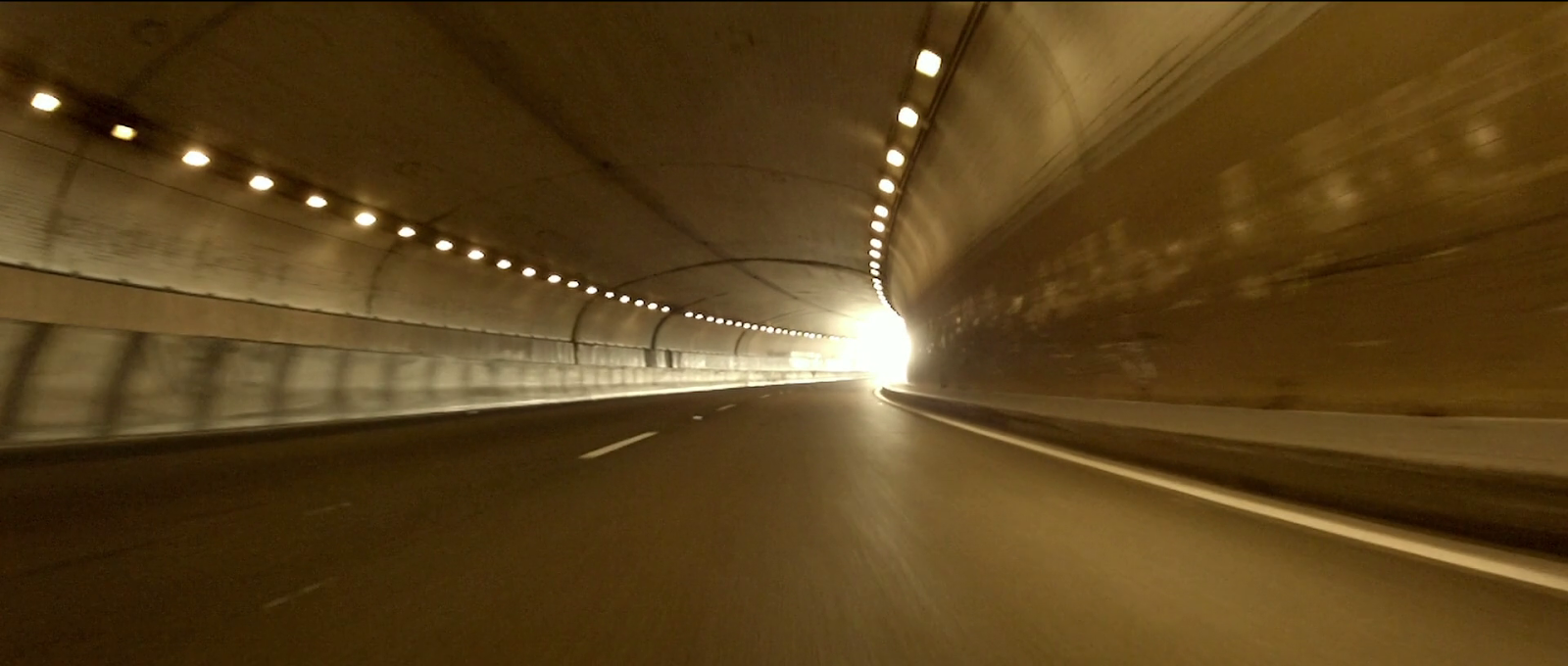
Another example from the film. Traffic viaducts and tunnels. Suppose you are filming a cinephile-flavored story in LA and suddenly you tell yourself: Why we don’t make all this boring concrete like passages from Solaris or something? Got the idea?


Love the way the bright sunshine appears at the end of the tunnel (blinding light plays a major role in Solaris). It is like being driven to a furnace: right to the magma of the director’s memory.
 
And one example more...

Why we don’t make of this girl (also) a muse of Kubrick or something?


Note the portrait.


*

The road and the car as symbols are as important as in Badlands. Like it was said, the road closes the movie. But this desire for movement promises little. This voyage through the land of cinema is giving us often the feeling of déjà vu... All right, second thought, this is supposed to be a big déjà vue.
 
The road in fast-motion, already used in The Tree of Life.
 
Anyway, what is new is the insistence in flying machines (lets forget the obvious birds), helicopters and airplanes. The first were already related with La dolce vita, a valid association, although it seems to be more than that (at least La notte and Apocalypse Now). As for the second, they are quite melancholic apparitions. They depart (from La jetée?), we stay.
 

Knight of Cups and La jetée. This boy also likes to watch planes.
 
*

“You had this dream with me in the center. It is not love, it is the sort of dream young boys have when they reach puberty, only you made it came true.” (The Collector)

“The truth lies not in one dream alone but in many dreams.” (One and a Thousand Nights)


Pygmalion dressing the statue, manuscript of the Roman de la Rose.

Dreams. One of the films leitmotifs, although only in one scene we see a typical representation of one (rather heavy-handed). A dream with a wave and a door is mentioned, probably relating with The Tree of Life, and also a dream with “a woman from another world” (besides the excerpts from The Pilgrims Progress)

The prince sleeping chez Norma Desmond.

Dreams are one of cinemas dearest fascinations. But certainly also of other expressions and ages. The last film invited us to an association with the Roman de la rose, an oneiric and allegoric pilgrimage of love. Something to have in mind.


Narcissus at the Fountain, manuscript of the Roman de la Rose

Suggestions:
More about pygmalionism (advanced reading).
About sleep.

*

Plenty of mirrors (one convex) and reflections producing doubles. A cinematic metaphor inseparable from Cocteau’s poet, no matter of how many different films it alludes to.


Suggestions:
Contains thoughts on convex mirrors.

*

The spiral, bien sure. Veeeeertiginous.

This sculpture (Robert Therrien), the lollipop and the dome of the German parliament suggest the spiral.
 

*

The tree appears in several forms, indoors and outdoors. The apparition of palm-trees is recurrent (see post on the trailer). They are a symbol of the city of dreams used in Badlands and The Thin Red Line. “Anything is possible.” In Vegas, they appeal to the idea of an oasis, or of a land of fertility and abundance (see the statue of Fortuna) in the middle of the desert.

The phallic value of the plant/tree points to Clockwork Orange (murder scene).
 

*

“Once the soul was perfect and had wings, it could sour into haven that only creatures with wings can be. But the soul lost its wings and fell to earth where it took a earthly body, now, while it lives in this body no outward sign of wings can be seen yet the roots of its wings are still there and soar with it into heaven. And when we see a beautiful woman or a man, the soul remembers the beauty it used to know in heaven, and that makes the soul want to fly, but it cannot yet. It is still to weak. So the man keeps staring up into the sky like a young bird. He has lost all interest in the world...”

Rick photographs the jellyfish with his phone. They were important in The Tree of Life. What memory they bring to him? And things like the ray or the weeping willow, also present in that film?
 
 
Malick’s key to his art of memory by Charles Laughton, or how to appropriate oneself of Plato. Nice choice, no? Not only Malick shows is humor subverting the philosophical horizon of the text, as he chooses a record from a great actor and director. Like it was explained, each and every thing in these films is there because it reminds the director of something else from somewhere over the rainbow. The film itself is the solution to fly.


Searching for memories of Marker. Observe Nancy closely, there are costumes, gestures and compositions that evoke La jetée. You know, Vertigo’s remake.


Suggestions:
On the films of Terrence Malick as an art of memory.

*

The moon. From the time of Mèlies’s journey, a symbol of the art, shinning in the night like the moving images in the theater’s screen. Distance and desire. “Let us live as no one has ever done it before. Wicked. Brave.” Murnau and the powers of the darkness: “Come to the city!”
 
At the drive-in theatre. The Tree of Life is a cabaret, it’s only a cabaret? I am pretty sure she has a bit of Fellini. The hat of Masina (La Strada), the belting of the vitelloni...


*

The Sun deserves one of the cards. The fire of the gods, source of light, energy, life and destruction. Knight of Cups confirms the more discreet role of fire observed in To the Wonder. Even so, it is mentioned (“So we are this, a fire.”), filmed (the candle, the bonfire in the rocks) and alluded (the burned house).

Notice also the wind, its call and energy (saw the electric chair?). The turbines call the memory of Days of Heaven (the generator).

Suggestions:
On wind.
*

- What’s your name?
- Whatever you want it to be. You pick. (...) You live in a little fantasy world, don’t you?
- Don’t you?
- Yes, because it is so much more fun.
- Enjoy yours?
- Uh-huh... Changes every day. I can be whatever I want to be. Don’t forget that. You can be whatever you want to be. You can be an asshole, you can be a saint, you can be... you can be a god. I’ll tell you, but don’t tell anyone, it’s a secret.

Some time ago useful thoughts about prostitution and cinematic fetishism were published around here. The High Priestess offers the creators most direct speech about this sort of relation with cinema. No clarification necessary, I believe. The “secret” joke is typical Malick.


- We’re in the old factory, and you’re the night watchman. No. Not quite. We’re in the dungeon of the Marquis de Sade, and I’m your prisoner.
- I wish you were.
- No. Wait. We’re in the Taj Mahal, and this is your garden. (...) This is the garden of the Taj Mahal. You know the Taj Mahal was built for a woman? (One from the Heart)
 

The idea of constant changing dialogues with some strong images of fragmentation and reconfiguration of feminine bodies, artificial or not. One opens this post, another is the bikini window at the strip club and another the video at the first party (by Quentin Jones).

 
The Tales of Hoffmann, the head of the doll.

Suggestions:
Notes on cinephile fetishism.
On its relation with Vertigo.
On its relation with prostitution.

*

The museum  an essential element in Vertigo  enters this directors filmography. Rick and Death romantically wander around works of art. As the natural stage and home of a “collection”, a concept essential from Badlands on, its importance to understand the “experiment” was already clear.


Suggestions:

*

The family. An old, vampiresque father, an angelic mother, a violent brother which brings the memory of Days of Heavens Bill. He has the need “to feel something.” Already Kit had talked about crushing his hands and Hollys. I would propose to interpret it in the light of the problem of inner experience, widely discussed on the blog. In Knight of Cups, life is called “a goddess.”


*

Feet. Cant say you werent informed about this guys crush on feet, but now you will be unable to watch the past films without remembering Deaths toes. By the way, sexual perversion was never so explicit in this directors oeuvre: the whipping, the leach, the lollipop and the toes in Ricks mouth, the dirty comments of the photo shoot, etc.

 
For some folks this sort of stuff is simply a Passion.

Suggestions:
On feet.

*

“This is death, don’t you see? Nothing but death. These are dead, I am dead, everything here is dead. Is that what you love, Death?” (The Collector)

Death. From the first post it has deserved our attention. This character in whom Buñuel and Bergman (note among other things that she bites his wrist: Persona, vampirism) resonate clearly (certainly there is much more) is called so not because of the abortion, whose reason is to be found certainly in some allusion. Note the wedding dress, it is an important element.


“There is no such thing as forever.” Also the vanitas type of images populate this film. Reflections, bubbles, skeletons.

 
Some suggestions:
On necrophilia (basic).
More on death.
And more (advanced reading).
On vanitas.

*

Transparent curtains and dresses too are once more important symbols.


There are also plays through glasses, invisible elements of separation.


Suggestion:
 
*


Stairs, movement towards the heights, light and revelation, were underlined in To the Wonder, and get some emphasis in this film too.


Suggestions:
Includes simple thoughts on stairs.

*


Remember these fundamental things apply as time goes by.